
47. The Weekly - Create Processes
On looping back around, scaling up and the 80/20 rule.

Welcome to the Happy Medium newsletter, this is part five of a ten part series sharing the Happy Medium 10 Rules for Staying Lean (and Stress Free).
Understand the point, cut everything else - 3 weeks ago
Create processes - Today!
Provide visibility - Next week
Trust
Culture
Understand before you act, but do act
Switching costs you
Rule #5: Create Processes
At a minimum you need a sales and a project process. But if you do something more than twice, create a process to make it easier in future.
Define your process
Process can get a bad reputation for being ‘work about work’ and not actual work. But when done correctly, having clear, decisive processes can be a game-changer to unlocking time and headspace in your business.
To avoid busy work, we want to refer for our 80/20 rule and look for the opportunity to cover 80% of our day-to-day with the 20% of processes we repeat most frequently.
In most small to medium sized businesses this 80% of workload can be covered with a strong Sales process and a Project process.
Let’s break these down.
Sales Process
The goal of your Sales process is to condense the time spent winning the work to the minimum amount of time as is commercially viable. This is because no one is paying you yet.
I’ve often seen the situation where teams have spent so much time in the back and forth to win the job that they have spent half the fee by the time the project starts. For example, if you’ve quoted for 15 hours of work, and spent 4 getting the job in the door, you’ve now got 11 hours left do get the work done and stay profitable.
A strong sales process paired with strong pricing framework takes the anxiety and second guessing out of the equation, leaving you headspace to focus on what’s in front of you.
This isn’t about rushing sales, rather having a clear and decisive process that helps the clients get all the information they need to make a decision, while presenting your work and value in the best, most relevant way.

Project Process
This is the process by which you deliver your service or product. Feel free to rename this to be most relevant to your business. If you have multiple offerings, you need a process for each but start with your most frequently engaged.
Finding, then protecting your creative process is important for a number of reasons:
Empowers your best work - Consistently great performance is important to grow a great business. Doing a good job for some clients and a terrible job for others won’t fly. You need to capture the elements that empower you to do a good job every time.
Gives clients confidence that they can trust you - Trust is the key to efficiency - you spend less time explaining and more time creating. The best client relationships are built on mutual trust.
Makes it easy for clients to understand - They have come to you because you are an expert, they are in unfamiliar territory so it’s important to make them feel safe and confident they can just leave it with you.
Reduces decision fatigue - You don’t need to use your headspace working out what is next each time, a process helps you know whats next. You have enough decisions in your day.
What does a good process look like?
Let’s start with what it doesn’t look like.
A bad process loops back on itself, decisions made at the beginning get unraveled, you can never confidently move forward.
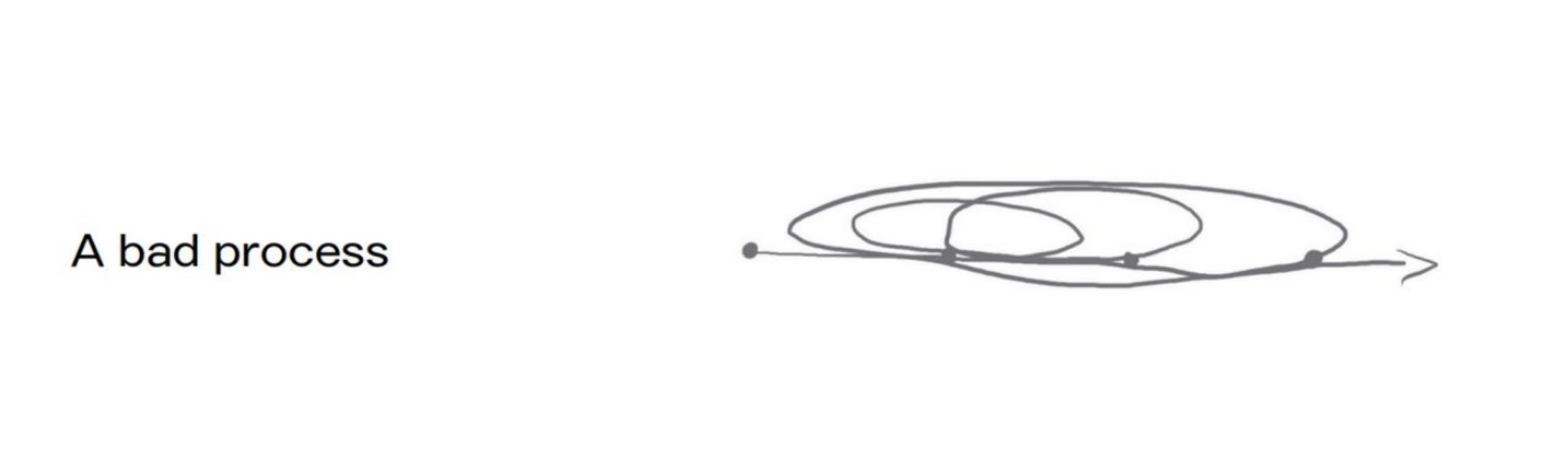
For example, you are a graphic designer presenting finished collateral and the client wants to change the logo or the colour scheme — all of the sudden you are back where you started.
This is how companies lose money without noticing, it feels like you are being productive because you are working on client work, but your hourly rate is now half what it should be because you’ve essentially done the project twice
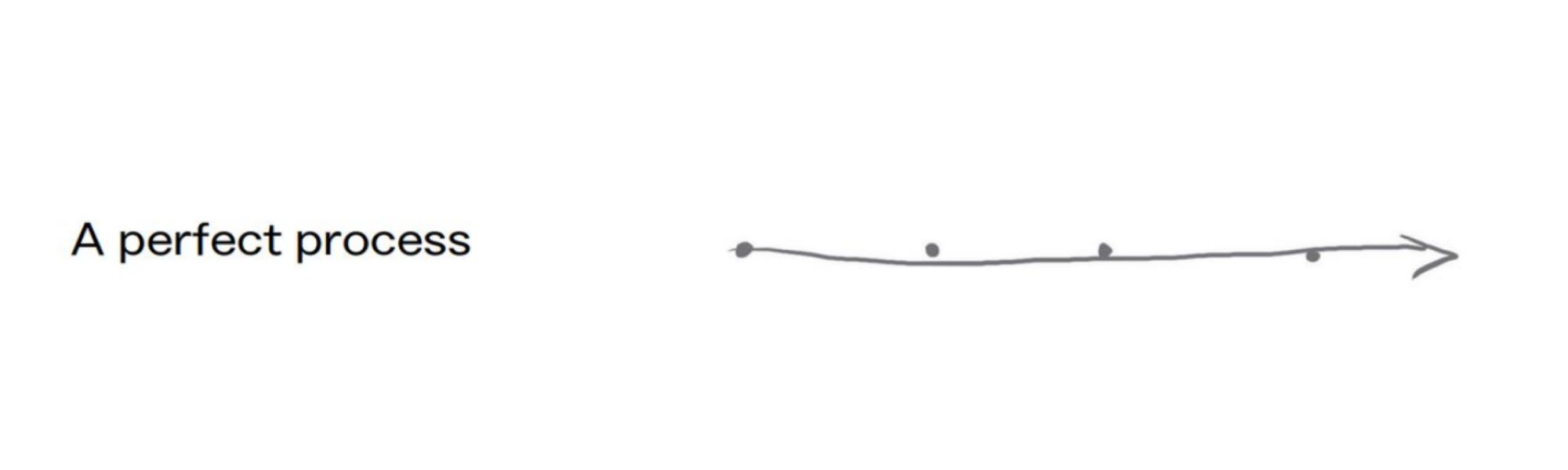
A perfect process - Client says yes to everything you present, no feedback, happy with it all! How great would it be if this happened…
Except that in my experience, this is suspicious, they either aren’t paying attention, don’t understand, the right people aren’t in the room or they have one big loop waiting for you right at the end.
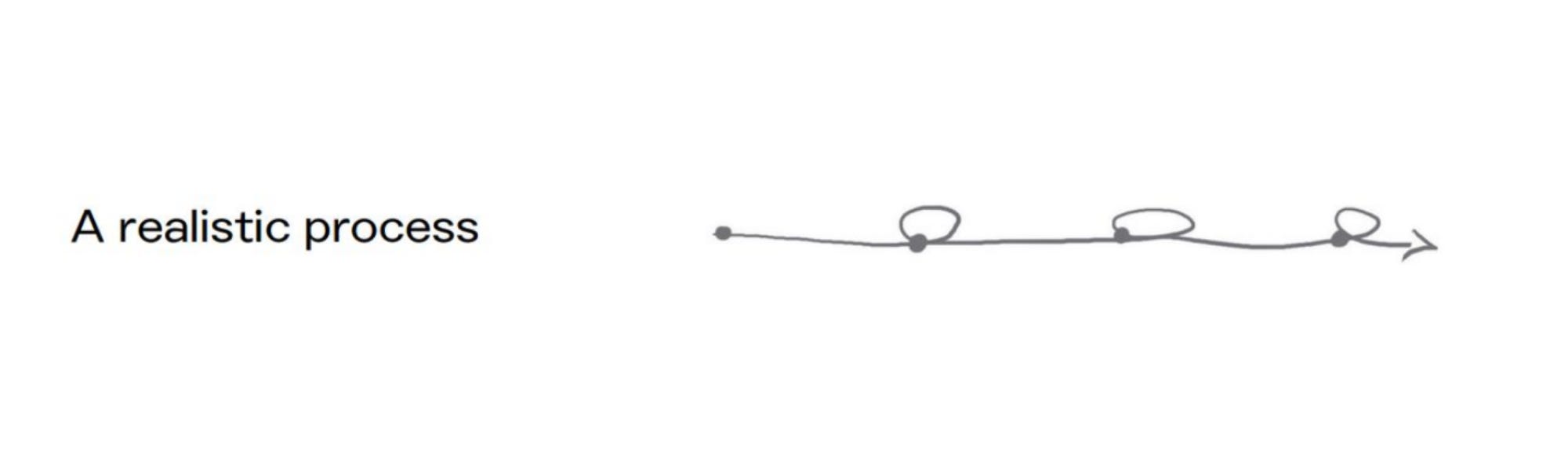
A realistic process is what we are aiming for. Feedback is contained to key milestones, you are still getting approval to move forward but it’s informed, everyone is on the same page about what is next.
A good process makes room for all necessary parts of a process. It’s realistic, leaving a little wiggle room but keeping it tight.
When designing your process, consider:
Client input - Brief & Feedback: what information do you need to get started or keep moving and when do you need it by.
Environment - Focus time, workshop time, digital environment
Collaboration - Who is part of your process, whose time do you need?
Incubation - Time spend away from the process (shower thought time)
Active Work time - Hours on the tools
When to improve a process
To realise the value of having great process, you need to give it a little room to breathe and mature. Start with a good process and iterate gradually to end up with a great process.
Avoid making changes when a process is in-flight. Always wait until the project ends and reflect on what could be improved for future. I find it’s helpful to roughly categorise business processes as either fixed, flexible or free so you aren’t constantly reinventing the wheel or focusing too much energy on something that working well as it is.
Having a good process is the absolute baseline for you to scale and grow. If you want to add automation, staff or clients a clear, a documented process is the essential first step.
Further reading:
If you’re struggling to define a strong Sales process, I highly recommend Tyler Archer.
If you need help with any other process, hit me up ;)
Interesting story underpinned by exceptional speed to market - you don’t get speed without great process maturity.

This is part five of a ten part series on how to be lean, if you aren’t already subscribed, you know what to do. Missed a week? You can catch up here and get a preview of what’s coming up!
A teeny favour?
My goal for this calendar year was to grow my Substack to 100 subscribers and I am so tantalisingly close with 41 days left of the year.
If you’re enjoying the content, or know someone who might, I would be very grateful if you could share this with them.
Or if no one springs to mind, leaving a like or a comment is always appreciated, by me and the algorithmic overlords.
Thank you!
Madeleine xx
ICYMI - Introducing Software Matchmaking 💛
A 60 minute session to target a software solution that can support your business.
There are limited spots available up to the holiday break, you can book in here.
That’s it for this week!
If you’re enjoying the weekly, please share with someone else who might enjoy it too.
Otherwise, if you aren’t already, subscribe to get these in your inbox every week or catch up on previous weeks below!
46. The Weekly - Create Frameworks

Welcome to the Happy Medium newsletter, this is part four of a ten part series sharing the Happy Medium 10 Rules for Staying Lean (and Stress Free).
45. The Weekly - Justify Costs

Welcome to the Happy Medium newsletter, this is part three of a ten part series sharing the Happy Medium 10 Rules for Staying Lean (and Stress Free).