
The most important skill you can learn...

When I first started in the working world, I found myself constantly frustrated by the way things were. I felt like it was so obvious what the problems were and I couldn’t believe no one was trying to fix these things. I always felt angry because things could easily be better and they weren’t.
Since then, I’ve calmed down a little and realised that while some things don’t make sense to a brand new grad, they do actually make sense. But I’ve also found that there are a lot of problems that are simple to solve, that we just allow to sit around and waste our time, money and headspace.
Thankfully, I also found a constructive outlet to channel that energy and actually solve those problems that bugged me so much.
I found it in the world of problem solving and not coincidentally I think that Problem Solving is one of the most valuable skills for the world we live in right now.
Since my frustrated grad days, I’ve solved problems for companies large and small, boring, creative, and complex and I want to share with you why I think problem solving is the most important soft skill you can develop, regardless of the industry you are in - or want to be in.
So what is problem solving? Well, it’s the ability to approach problems confidently, break them down into their components, uncover the root cause and then be able to formulate a solution.
But just coming up with a solution isn’t the end, great problem solvers know how to execute on that solution. They can be strategic when they need to be but they also know how to get their hands dirty and get things done.
With any discussion of soft skills that are marketable and hireable, it’s only natural to start with the natural first question - can I get a job with this?
I don’t think anyone would be shocked to hear that the job market is undergoing significant changes. Some of that is to do with AI, and we’ll come back to that, but it’s actually a shift that has been ongoing for decades and will continue to evolve for a long time yet.
People don’t stay in jobs for decades, fractional and portfolio work is on the rise, retirement is a softer transition that it used to be, more women are graduating, studio budgets continue to shrink. Some of these things are better, some are worse but what we can bet on is that change is the only constant.
All of these things mean that the job market your parents or your older sister or even the person a grade ahead of you applied to, isn’t the one you are applying in - and it will always evolve.
One of these shifts is that output has now become incredibly cheap. For example, McKinsey recently bragged that they are now employing 25k AI agents to produce over 2.5 m graphs annually
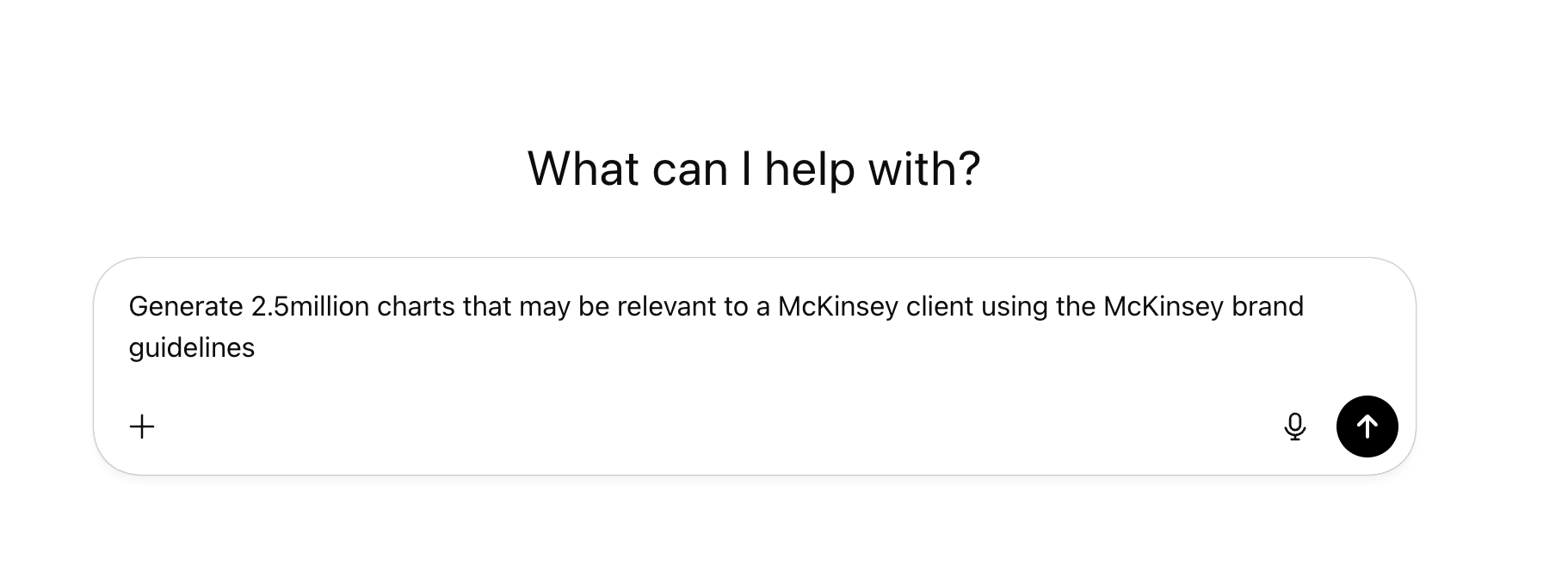
But quantity has never meant quality and this remains the case. While content and information have never been more abundant, meaningful insight remains valuable. The more noise, the more valuable are those individuals who can find the signal.
The thing about AI is that by definition is can only pull from what already exists so in this way AI has dropped the low hanging fruit to the ground. If you want to pursue the status quo and do things the way they have always been done, AI will help you do that at record speed. If you want to do something new, it wont.
What problem solving helps you do is to make sense of the signals in the noise, to be able to synthesise and understand what is meaningful - what actually effects things - and what is just decoration.
Knowing how to define a problem properly, limit the scope effectively, design good solutions that approach root causes (not just bandaids), then actually execute effectively is a great skill to have. People think the work is over once they come up with the solution, no, that is just the beginning.
Surface level knowledge is very easy to come by - you can watch a 10 second video and feel you know all there is to know on a topic (this is very cool by the way). But while knowledge is awesome, experience is invaluable. The combination of these feeds intuition which is something that AI can’t replicate.
Many things become less obvious as you go deeper into them. Many more things make a ton of sense on paper but don’t stand up in the field.
When you know a little bit about something, you feel like you know a lot, but as you begin to learn, you start to understand how much there is to know, and by comparison how little you actually know.
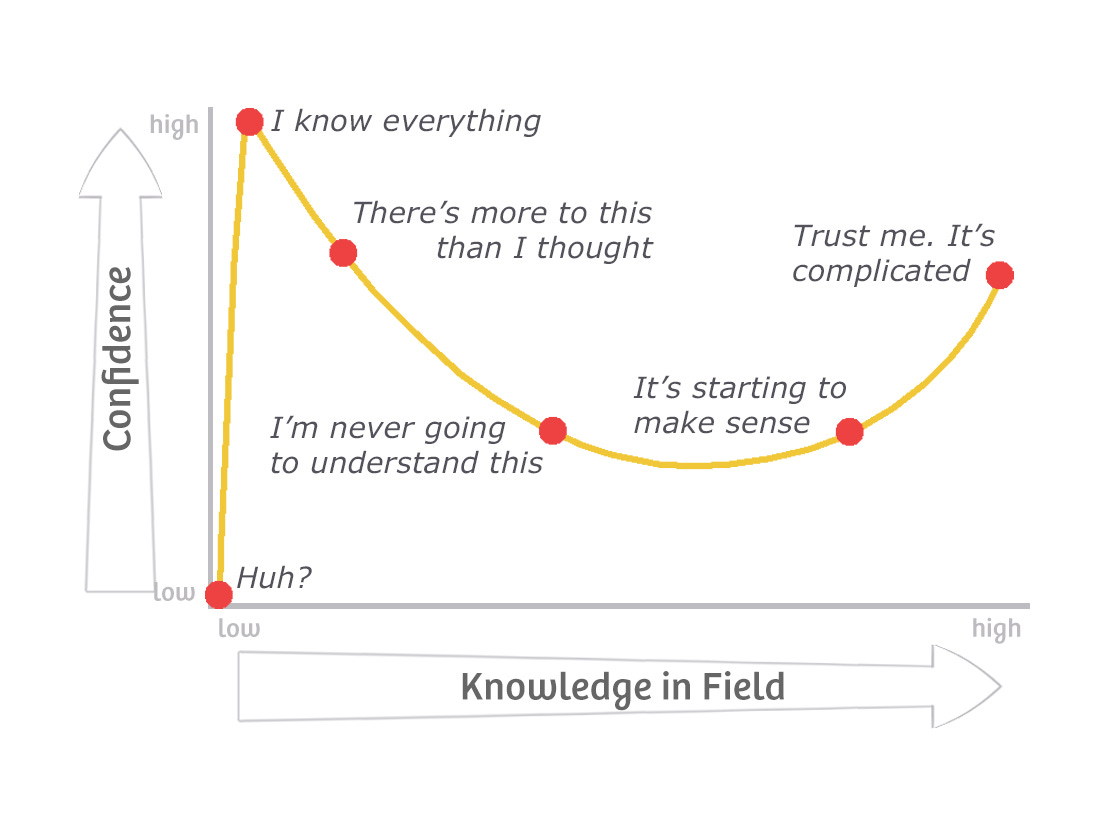
Being able to pair knowledge with experience is the way to move past being an insightful person - which is nice but the world doesn’t need more hot takes, trend reports and surface level observation - to becoming an effective person, which the world very much does need. Knowing a little about a lot is not that useful anymore, knowing how to get stuff done, is.
This is where diversity of experience is a superpower. (Straight up diversity is too). There are a lot of people who are great at Skill 1, and a lot of people who are great at Skill 2 but the intersection of Skill 1 & 2 thats a unique niche, that’s where you are uncovering innovation.
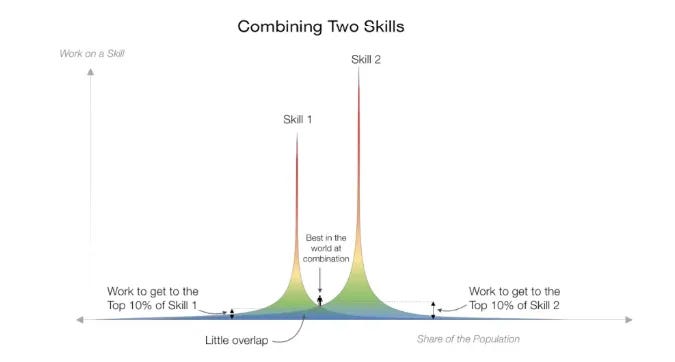
Having the experience of a different culture, industry, workplace, etc all adds to those overlapping intersections that make your skills uniquely valuable. Adding problem solving as a skill to what you are already good at is a unique niche advantage.
I’ve worked in a lot of different industries and types of business and there are things that are done really well (and really poorly) in each which can be leveraged in new environments.
Things that are proven to work well in one industry that can be lifted and shifted into a new one, you are leveraging all this proven success.
The classic example is surgeons learning from F1 pit crews how to improve safety & efficiency in paediatric surgeries - but it could also be as simple as bringing the firmness and confidence from how a lawyer speaks into a creative context; or effective triage skills from a control tower to deal with an overwhelming call centre; or bringing a system or behaviour that works well in your home country to a new location. (Related; Mike Carson on the power of being a multi-hyphenate).
Invention often sits at the intersection of two seemingly unrelated interests. Having diverse interests is valuable, as is having connections with people across categories, not just in your own little world.
I’ve noticed that the industries are the most insular are the slowest moving. They are bogged down by their own lack of confidence, they eat their own and they are hostile to outsiders. They can’t innovate.
Problem solving can sit adjacent to continuous improvement which can get a bad wrap for being overly theoretical, slow moving or irrelevant. And this isn’t totally an undeserved reputation - there is a tendency to design for coherence, not function. A perfect example of that is a large organisation with all it’s processes mapped cleanly and carefully…but the day to day is chaos.
Looks great, leadership feels like they have a grasp on things. But on the ground, people are working hard just to make things work. Those processes are never referred to or used, they are just artefacts, busy work.

Designing for coherence, not function, is like flying over a city with a helicopter and rearranging the city to ‘flow’ but ignoring the fact that very few people experience the city from up here, and none of them make use of it. The only way to use the city is to be in it.

The world is not designed for coherence, its designed to function, so when we try to approach systems top down, we miss the point. People don’t exist at the top, they are inside the city, so designing for the top helps no one - even if it visually looks great.
The value is in the detail, in the lived reality.
Being able to solve real, actual problems that you come across in your day-to-day is super empowering.
Problems shouldn’t be solved by people being airdropped in from the helicopter - the skills need to be employed by people who know a lot about what they do, because those are the people that will really be able to make a difference. They know what it’s like on the ground.
The old model of bringing someone in to come and fix everything is dying - it’s been dying for a long time. If my McKinsey example from earlier didn’t convince you, the consultancy model is fraying at the edges. Related: Terry Young on compressing complexity for legibility)
I’m not anti consultant (I even call myself one) and I think there is huge value in bringing someone in to give fresh eyes to your business with the benefit of their experience.
But the thing they don’t advertise is that consultants are often just good problem solvers, sure they have experience doing the same change multiple times but actually the skill is in being able to find a way through a problem. If you’ve done it before it’s a little easier, and the more problems you approach, the simpler they are to resolve even if it’s a totally new problem.
But this means that these skills can be learned by anyone- and it’s easier than you think! Instead of spending millions, touring with the helicopter and parachuting in external people to solve problems, equip those on the ground with the skills to solve their own problems. You’ll get better, quicker solutions - and it will cost you significantly less.
Okay but this isn’t just about approaching big problems, reducing the wasteful activities that burden our businesses and lives at the task level can be hugely beneficial. If we can chip away at the small things that waste our time, headspace and energy, we have more to time to think, be with our families, work on other projects, watch more tv, whatever you like.
It’s not this idea of ruthless efficiency where everything that doesn’t produce a dollar gets whittled away - that is enshittification and there is enough of that going on. Enshittification is the trend you’ve no doubt interacted with, where products get worse and worse as they are optimised for metrics irrelevant to the customer experience (but very much correlated with profit). (Related: Hanna Horvath on where the money is going).
It’s not sustainable, it’s not valuable and it’s not enjoyable.
Good quality work needs a mission that is beyond metrics. Goodhart’s law states that ‘any metric that becomes a goal ceases to be meaningful’.
Metrics should be the information that tells you whether you are on track or not. It’s like driving a car, you have all these dials and screens telling you the temperature of the engine, where your fuel is at, the air conditioner settings, how fast you’re going. These are all giving you information but the ultimate goal is to arrive safely at the destination. You’re not going to ‘optimise for engine temperature’, you’re going to pull over when it starts flashing. (
When you optimise for these random metrics, you will introduce waste because you are focusing your energy in the wrong place.
Being a good problem solver means you can target wasteful activities that add nothing and detract from your mission (not to mention your headspace, energy and time).
For example, a friend of mine is a doctor at a hospital in a remote area.
The patients she sees often come from even more remote areas, so they need their appointment to line up exactly with when they will be in town, otherwise they need to wait another 6 weeks. When you have an illness that needs consistent monitoring, you can’t just skip an appointment. The problem is that on any given day the bookings are completely full, however only 50% of the patients are actually showing up. This is a huge waste of hospital resources, of people’s time. So why is this happening?
The administration team is responsible for booking patients in, and on paper their metrics are looking great; short wait times for an appointment, clinic is fully booked. Wow great, so what’s the problem? Well we are looking top down, we need to get inside the city, what is the process from a patient’s point of view?
Inside the city, patients are receiving an email advising them of their next appointment date. If they see the email, they have the option to accept, decline or reschedule. Clicking reschedule automatically assigns them to a new date. Unless they click reject, they are assumed to be attending and the appointment is kept.
Our biggest problem here is that patients are unable to select a date that works for them at any point in the process. Additionally, many of them don’t communicate frequently on email and aren’t seeing the message, but the appointment is held if there is no response.
Now the knee-jerk reaction is to implement a better scheduling software that makes all this easier, but let’s pause. If you do that, you’ll be adding something new to a process that is already not working.
The heart of this problem is an inconsistent goal - our Admin team is optimising for efficiency as measured by their metrics. This is not a mission.
What is the most important goal for this clinic? Good outcomes for patients. At a minimum we can define this as a medially appropriate appointment regime. This is a goal that everyone in this scenario can share - the clinic staff, the admin team and the patient.
What the problem actually is, is that the administrative staff are not aligned with the best outcomes of the patient- or the clinic for that matter. They are following a process that is optimised for metrics, not the mission.
So if we want to solve this problem, let’s have a look for something I call Shadow Processes. These are the unofficial processes that support a broken system. You need to be in the city to find these, you can never see them from the helicopter.
Doctors are spending their time calling each of the patients to coordinate times that work for the patient, then sitting on hold to the admin team to ask them to manually change it for them.
This is not good use of the doctor’s time but now we know what does work for our patients; a phone call.
We are going to feel some friction from our admin team. They thought they had a great process and we are about to ruin their stats. Ignoring the human desire to feel like you are doing a great job will undermine your solution, you need to lean into it and communicate a case for changing the process that helps everyone get on board.
That could look like this:
We all agree that our mission is to do our best work for patients, we know that this means a medically appropriate appointment schedule.
We’ve found that over the past 6 months, 50% of patients have missed their appointments because they were not scheduled at a time that suits them. Due to the remote nature of the clinic, a missed appointment means months of delay, not days.
We’ve found something that works and we’d like your support so we can take this off the doctor’s hands: calling each patient to coordinate an appointment regime.
This might seem more manual than you are used to but one phone call will reduce the back and forth on email, improve the effectiveness of the clinic but most importantly, will improve patient outcomes.
Once you have this up and running, you’re more than welcome to continue to optimise this process so long as it’s aligned with the mission.
It’s not about doing less work, its about doing better work that delivers outcomes for everyone. This solution hasn’t cost us any money, we haven’t had to make cuts or restructure, we haven’t invested in rolling out a new software, but it will make a difference for the patient and the clinic.
This kind of problem is not fixed externally, top down. You have to understand the perspectives of everyone involved.
This might not seem like the biggest problem in healthcare but being able to solve small problems like this add up. At a time when budgets are tighter than ever, sinking money into dumb processes is something we literally can’t afford. Because when budget cuts happen, they happen top down and they take important things with them as collateral. When the hospital trims their budget, the little admin team probably wont even show up as a target. And if they do, they’ll end up trying to hold up a bloated process with less and less people.
But by shifting our focus to a mission and doing what makes sense to achieve that mission, we free up some mental load. We are not striving to make abstract numbers go up and down, we are using the feedback from our metrics to stay on course.
Being empowered to solve these problems in the way you want to see them solved, targeting things you see and feel on the ground, gives you the power to control how your time is spent.
These types of problems clog up our businesses and our heads. The fight for attention is more brutal than ever. There are multiple multi-billion dollar organisations fighting to commodify the space in your brain - so it must be valuable. If you can retrieve some of it from bad processes, it improves your quality of life.
Okay so now I can hear some murmuring behind the screen, this sounds great but there are so many people involved, there are so many layers of hierarchy and my boss won’t let me.
No problem, this next part is for the managers, founders and leaders;
Hello boss, I understand the struggle, there is a lot on, so much to do and this person won’t stop coming up with new ideas that you’ve seen played out and fail. You appreciate the energy but need them to focus on the work that they’ve actually been assigned so you can get your stuff done.
Two things to consider here. The first is that over time that light inside them will die if they continue to chug meaninglessly at the powerpoint factory, and people who are new or fresh can often see glaring inefficiencies with amazing clarity because they weren’t part of the sunk cost that arrived at the current process. Harness that energy.
The second is that these things, this undercurrent of bloat, will eventually swallow the company, it might not happen for a while but it will eventually. Do you want to be the one that fixed things before it’s too late? The metrics might look shiny and good but we need to look up from the dashboard and make sure we’re on track to the broader mission.
But your instinct is right - things haven’t got off the ground in the past, so help them to push past that awkward phase. You need to equip them with the skills to properly explore and execute those good ideas, develop the discipline it takes to push a good idea through to reality, otherwise you are correct, they will go no where. I can help you with this and you’ll find the links to my courses below but I’ve also included some tips to get you started.
And finally, if your team trusts you enough to send you this, you are doing a great job! Help them solve their own problems and free up a little of your headspace too.
Don’t worry, they will come around…
So now is the time that I’d like to mention my Problem Solving courses which are specifically designed for teams that want to work smarter, not harder, to deliver really great value.
But I don’t want to preach about how important these skills are and then hide them behind a paywall so let me leave you with some high key things you can do to start solving problems today.
Optimise for a mission, not metrics - Have a north star and head towards it, remember metrics are information to help you stay on mission - they are not the mission.
Define a problem properly and limit the scope - Solve one thing at a time. This is the antidote to feeling overwhelmed by big problems, get good at solving lots of small things that are always mission aligned.
Design for function, not coherence - Get a grasp at ground level before you start trying to improve anything.
Identify the shadow process and learn from it - People are natural efficiency finders, they will seek the shortest path, so for every bad process, there is someone sticky-taping something that actually works together, find them and help them.
Lean into to cross functional, diverse thinking - this is how you break out of the status quo, be curious and leverage the lessons learnt in different worlds.
Bias towards action - Do the thinking, but then act. It’s experience that turns insight into impact. A million good ideas have died on the page, to make change you gotta make things real.
So to close, I hope I’ve convinced you that problem solving is the most important skill you can learn in your career and your life. The world needs more people who aren’t scared of problems, people who are comfortable working with constraints and ambiguity, who aren’t afraid to try understand why things are the way they are.
And this is not just for business-ey people. Creative people are actually already equipped to be great problem solvers, you already know how to work within constraints, you know what it means to seek inspiration from new and unusual sources.
It can feel overwhelming to see the state of the world and feel like that if you aren’t one of these powerful people, there is little you can do. But there is a lot you can do, even if you tidy up a process that only bugs you, you have scraped back a little headspace for yourself. And getting that headspace back is an opportunity to reinvest it into something you actually care about. Remember, those powerful people are just some guy - but you are also just some guy! (Guy in the gender neutral sense of the word of course.)
I also don’t want to pretend that some problems aren’t large, complex and systemic - sometimes built over hundreds of years. But it’s people that build systems and constructs and if you find yourself frustrated by them, you are also a person and can design for something better. Start small, start chipping and stay on mission. Share this message with like-minded people and work together.
If you’re a manager, founder, boss, owner - a quick and easy thing you can do is sign your team up for my courses. I have two that are particularly relevant. Problem Solving Mini is 1.5 hours, and details 8 key types of waste that clog up most businesses and how to solve for them. We do an example together which can be tailored to your specific team so you’ll get real worked examples out of the session. It’s great for getting everyone on the same page with a shared vocabulary.
That is a great place to start but if you want to level up Problem Solving 101 is more in-depth and teaches you a toolkit that you can use to become a great problem solver. This is a great option for the natural problem solvers in your business that could use some tried and true tools to amplify their impact.
Otherwise, join me on here on substack for more on creative business, problem solving and inspiration - if you enjoyed my references throughout, I often share the things I’m reading and writing about online. And of course, like, subscribe or send this to your work-wife (in the gender neutral sense) who you love to rant to and turn those rants into change.
And finally a shout out to all the colleagues throughout my career who have helped me channel my own rants into this productive outlet. Thank you, your patience is immeasurable.
Have a great day guys and happy problem solving!
If we haven’t met…
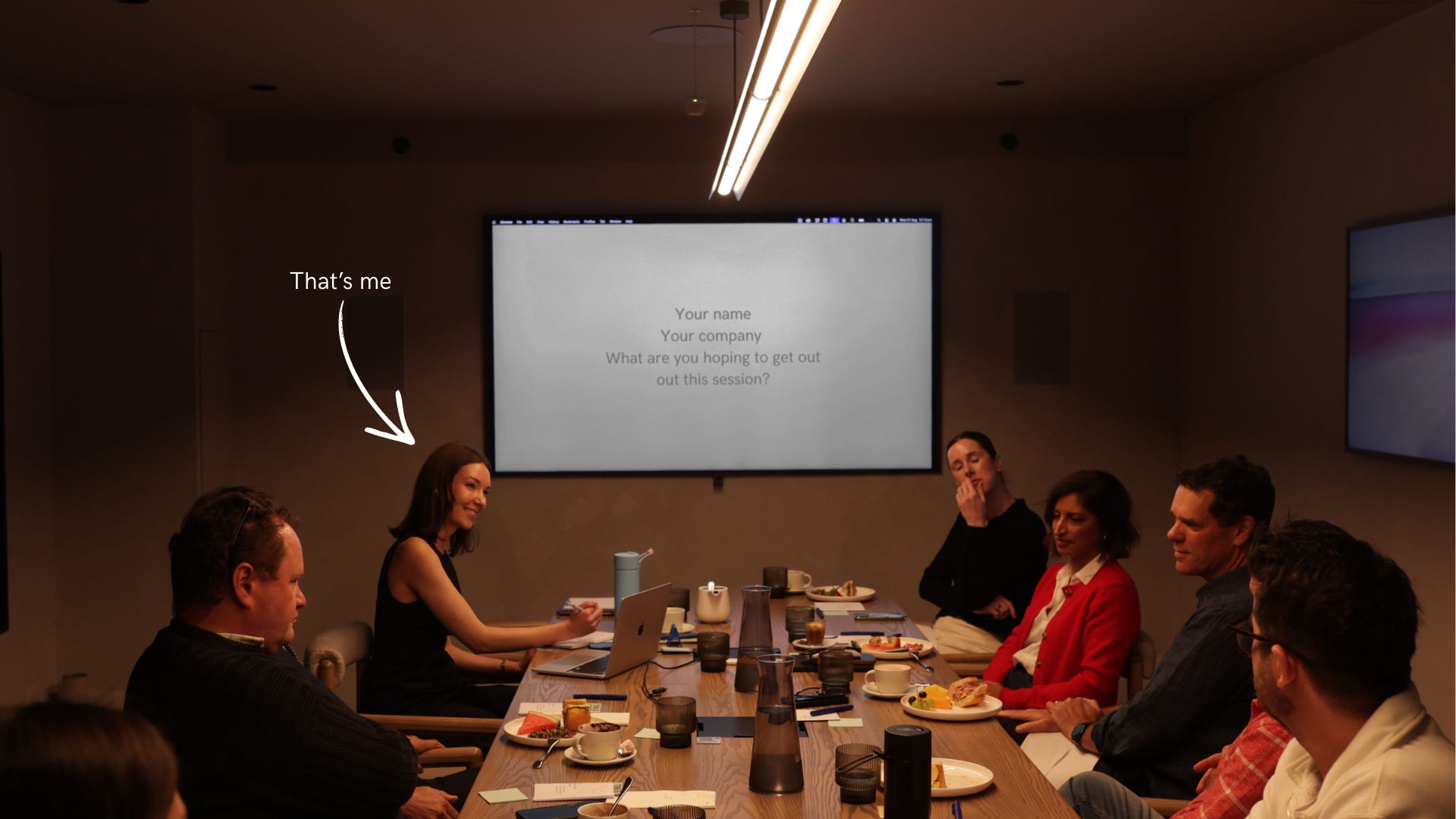
Hi, I’m Madeleine. I’m a business efficiency consultant and strategic advisor who specialises in helping creative businesses thrive through practical problem-solving and streamlined operations.
With over a decade of experience across operations, project management, and business transformation, I’m all about bridging the gap between creative vision and operational excellence.
Finding the Happy Medium is all about balance; growth that feels sustainable and enjoyable, never overstressed nor stagnant.
Want more? Check out my ten part series on staying lean and stress free)

🙌🏼
This is strong.
The distinction between designing for coherence and designing for function is the real hinge here.
I see this constantly. Beautiful dashboards. Clean process maps. Perfect language. And then chaos on the ground.
When metrics become the mission, intelligence shifts upward and responsibility shifts downward. That’s when shadow processes take over.
The hospital example captures it well. The system wasn’t broken because people were incompetent. It was broken because incentives were misaligned with purpose.
Problem solving isn't about cleverness. It’s about alignment. Mission, incentives, behavior, lived reality.
When those line up, things move.
When they don’t, no amount of optimization saves you.
Really thoughtful piece.